Tempco Blog articles

Beer, wine and exchangers, thermal treatments in food processing

Applications within the food and beverage industry widely employ heat exchangers, both plate heat exchangers or shell and tube exchangers. This is due to the fact that food products, and beverages such as beer and wine, are all subject to special thermal treatments required for their processing, in order to achieve defined temperatures to enable some reactions or stabilizations, or also in order to ensure their correct conservation.

For example, once the hopping cycle is done, beer has to be cooled before it can be introduced into fermentation equipments, bringing it at the correct temperature required for the fermentation process. Wine is subject to aging processes, or also pasteurization, and each thermal treatment is necessary to obtain organoleptic characteristics that make it a fine quality product.

Another example is milk, which has to be pasteurized using thermal cycles at high temperature and then at low temperature, and then a conservation phase for a certain period of time at a specific temperature.

This is to explain that all of these products are subject to thermal treatments aimed to enhance their characteristics or also to guarantee their proper long-term conservation and food safety of the product on the shelf of a store.

All of these thermal treatments are achieved using heat exchangers, that have to be realized in special and dedicated executions. Being aimed to work in direct contact with food products, indeed these have to be certified exchangers, made using certified materials and with specific surface treatments and finishings, being free of hollow areas and spots ensuring a smooth design where food or dirt can’t accumulate, possibly leading to bacterials proliferation. Furthermore, seals have to be FDA approved, or by some other else responsible subject, in order to guarantee they are suitable and compatible with food contact.

Also the connections have to be of a certain kind, enduring easy disassembling and cleaning operations, and usually the overall construction of the equipments is made in stainless steel. These are in fact equipments aimed to frequent and constant sanitization and washing operations, in order to guarantee maximum safety and compliance with hygienic requirements for food processing.

Stay updated on the latest applications by subscribing our monthly Tempco Newsletter – Solid Temperature.

Special plate heat exchangers for oil&gas applications

Plate heat exchangers are quite simple equipments with a very consolidated technology for thermal transfer in industrial processes. The kind of application can anyway require very special adjustments and engineering attentions that can turn a common plate heat exchanger into something very special. A typical example is the oil&gas industry, which entails a very much more accurate design of a plate heat exchanger, with a series of special engineering features:

  • Anti-corrosion coating cycles (such as for C5 M environments)
  • Stainless steel nameplates and data plates
  • Line connections made in AISI 316
  • Thermal security coefficients increased (suitable fouling factor rate)
  • Earthing systems
  • Declaration of conformity for ATEX area installation
  • Certifications of materials

These features are referred to the construction and selection of constructive materials of the plate heat exchanger, but also to all the engineering evaluations and the technical documentation required to ensure the exchanger is suitable to cope with the challenging conditions of the harsh industrial environment.

Tempco Scambiatori di calore a piastre petrolchimico

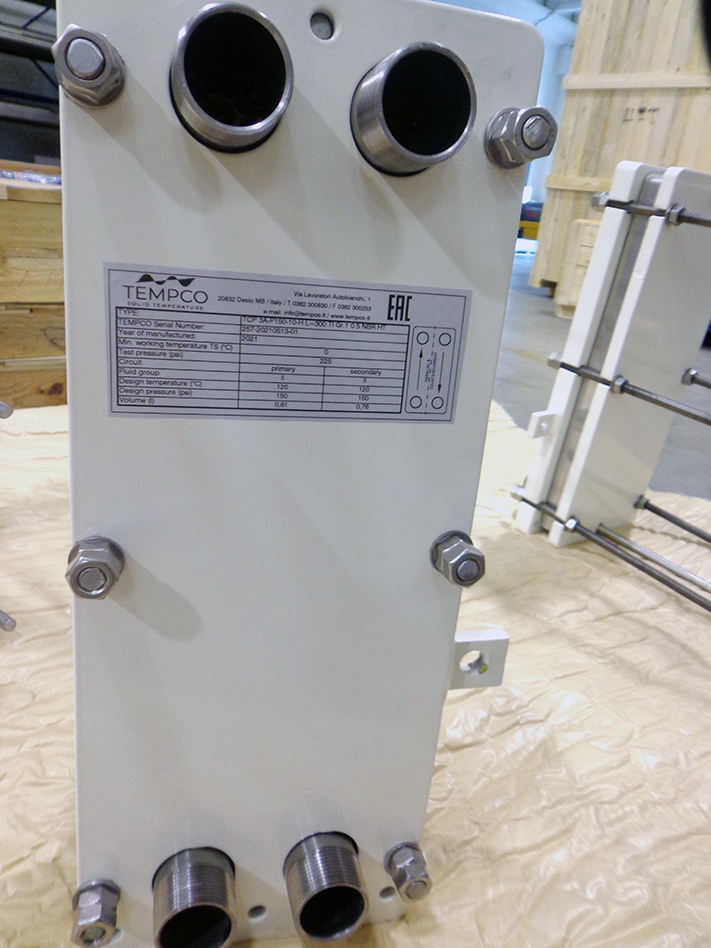
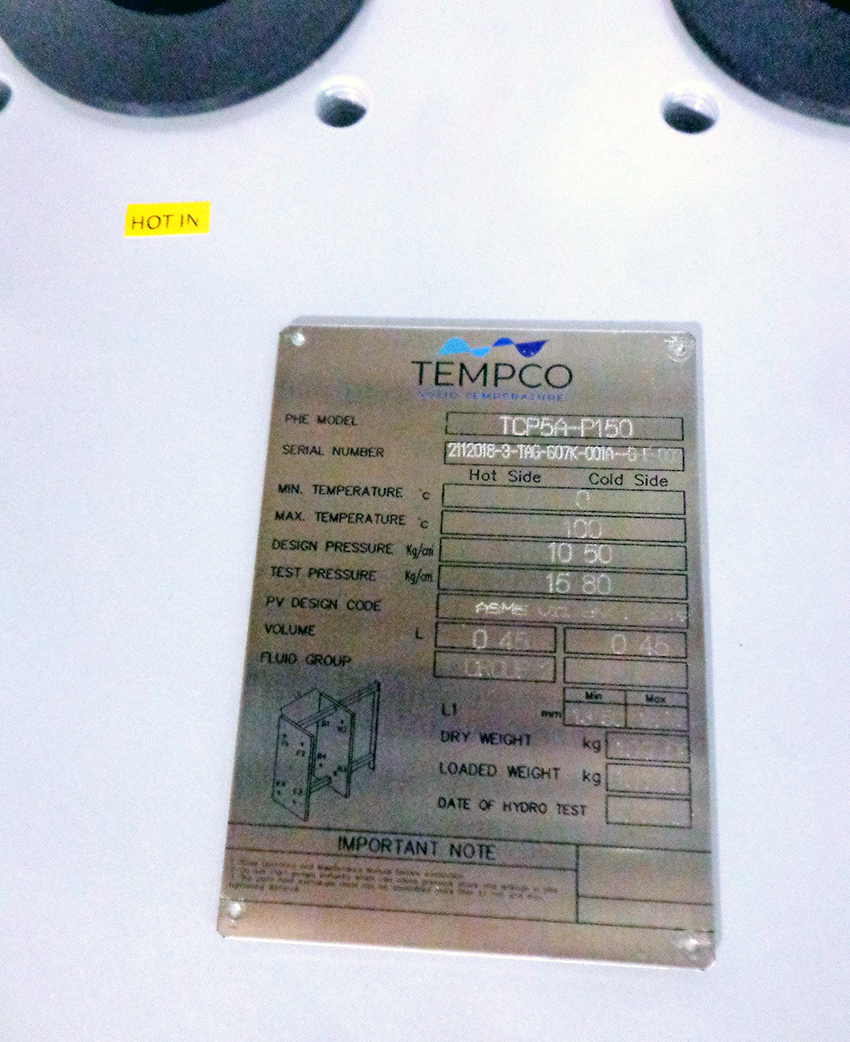
Tempco Scambiatori a piastre petrolchimico targhetta inox

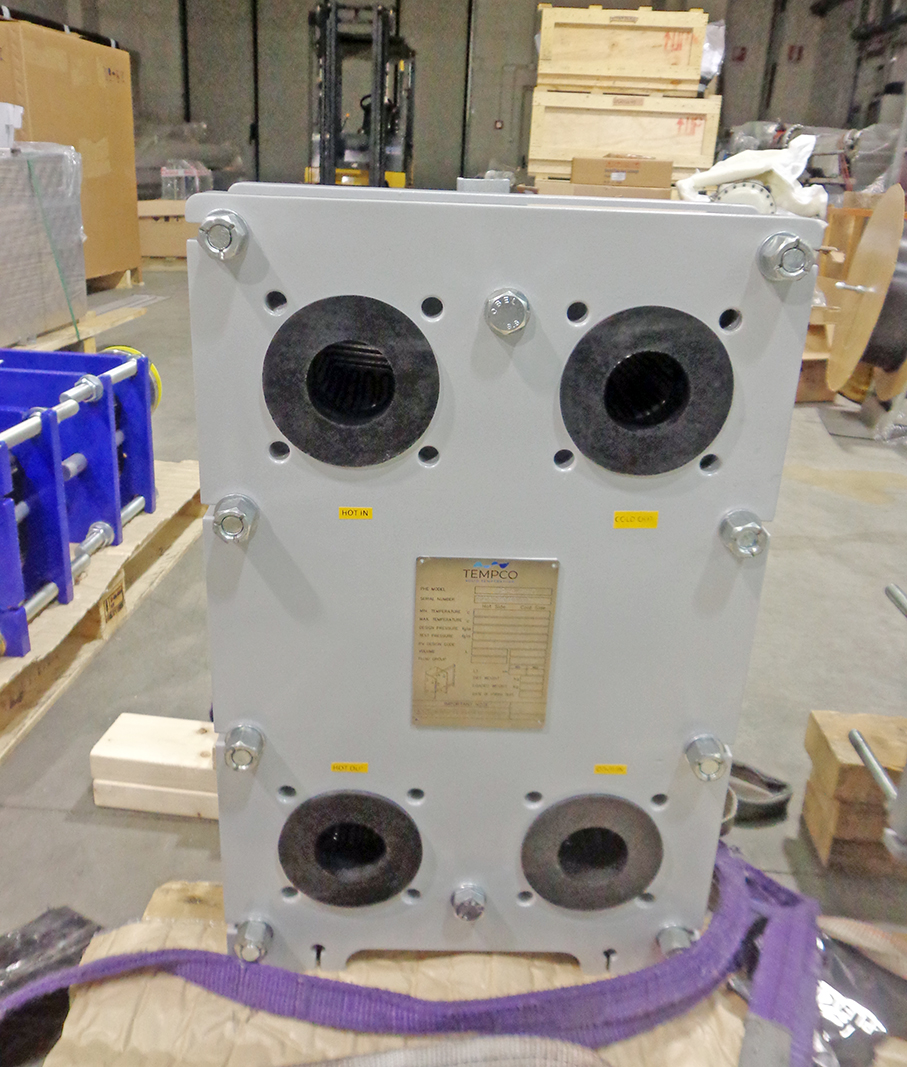
Tempco Scambiatori a piastre petrolchimico


Stay updated on the latest applications by subscribing our monthly Tempco Newsletter – Solid Temperature.
Fluid’s flow in heat exchangers, counter-flow vs. parallel-flow

What’s the difference between counter-flow and parallel-flow heat exchangers, and why and when the two typologies of thermal transfer are employed?

We’re talking about the flowing of fluids in heat exchangers, which means counter-flow and parallel-flow exchangers. The meaning is said in the word itself: in a counter-flow exchanger, the two fluids exchanging thermal energy each other flow within the exchanger in opposite directions.

This is easy to understand with plate heat exchangers, where counter-flow means that one fluid flows top-down and the other goes bottom-up. In one-pass shell and tube exchangers, there is a fluid flowing inside the shell and the other flowing inside the tubes in the opposite direction. A little more complicated to understand with multi-pass exchangers. In an air-cooled exchanger, a finned exchanger, finally, the air flows in the opposite direction compared to the water.

Parallel-flow is the exact contrary working principle, with both fluids flowing in the same direction.

The most relevant difference is that a counter-flow exchanger achieves higher thermal transfer rates, allowing to obtain output temperatures of one fluid very close to the inlet temperature of the other. And it works for both cooling and heating. In addition, in plate heat exchangers is it also possible to have temperature crossing, obtaining much higher efficiency and thermal transfer coefficients than comparable temperature crossing in other kind of exchangers.

Parallel-flow thermal transfer doesn’t therefore allow temperature crossing, because the temperatures of the two fluids will tend to be very close during the overall process, from start to finish. This is employed when a process requires heating, cooling or thermal transfer tasks that are less intense and invasive, and so more ‘soft’, involving a lower thermal impact upon the product which gets cooled or heated. For example, thermal transfers in the pharma sector or the food industry, where the product to be cooled/heated needs specific thermal schemes with no shocks, that otherwise could cause an alteration of the product itself compromising the quality of the final product.

Stay updated on the latest applications by subscribing our monthly Tempco Newsletter – Solid Temperature.
Newly refurbished References section in Tempco’s website

A new and renewed section dedicated to the References of Tempco’s application in a series of industrial sectors, already available in the Italian section of the site, is being added and updated on our Tempco website.

The References section includes a complete series of success cases deployed by Tempco over the years for the Food and beverage industry, the Automotive sector, chemical and oil & gas, applications for renewable energy, pharmaceutical production, rubber and plastics industry, paper, metallurgy, power generation, research and engineering and the textile industry.

A very wide and complete amount of applications is featured in the section, classified by industrial sector of destination and employing the whole range of thermal energy management equipments and machinery offered by Tempco: plate heat exchangers, shell and tube exchangers and dimple jacket exchangers, thermoregulating units and chillers, evaporative towers, free cooling and energy recovery solutions, high efficiency cooling and heating equipments.

Each applications is completed with a description of the kind of industrial process involved and its requirements in terms of temperature regulation, the solution that was designed and the machines and equipments employed in the making of the plant. An overview sheet, that can be downloaded in PDF format, offers then a summery of the characteristics of each application, providing a complete view of the several solutions for thermal energy management in all industrial sectors in which Tempo operates.

We therefore gladly invite you to discover the wide range of industrial thermoregulation and temperature regulation applications developed by Tempco, always being updated, and enjoy the navigation!

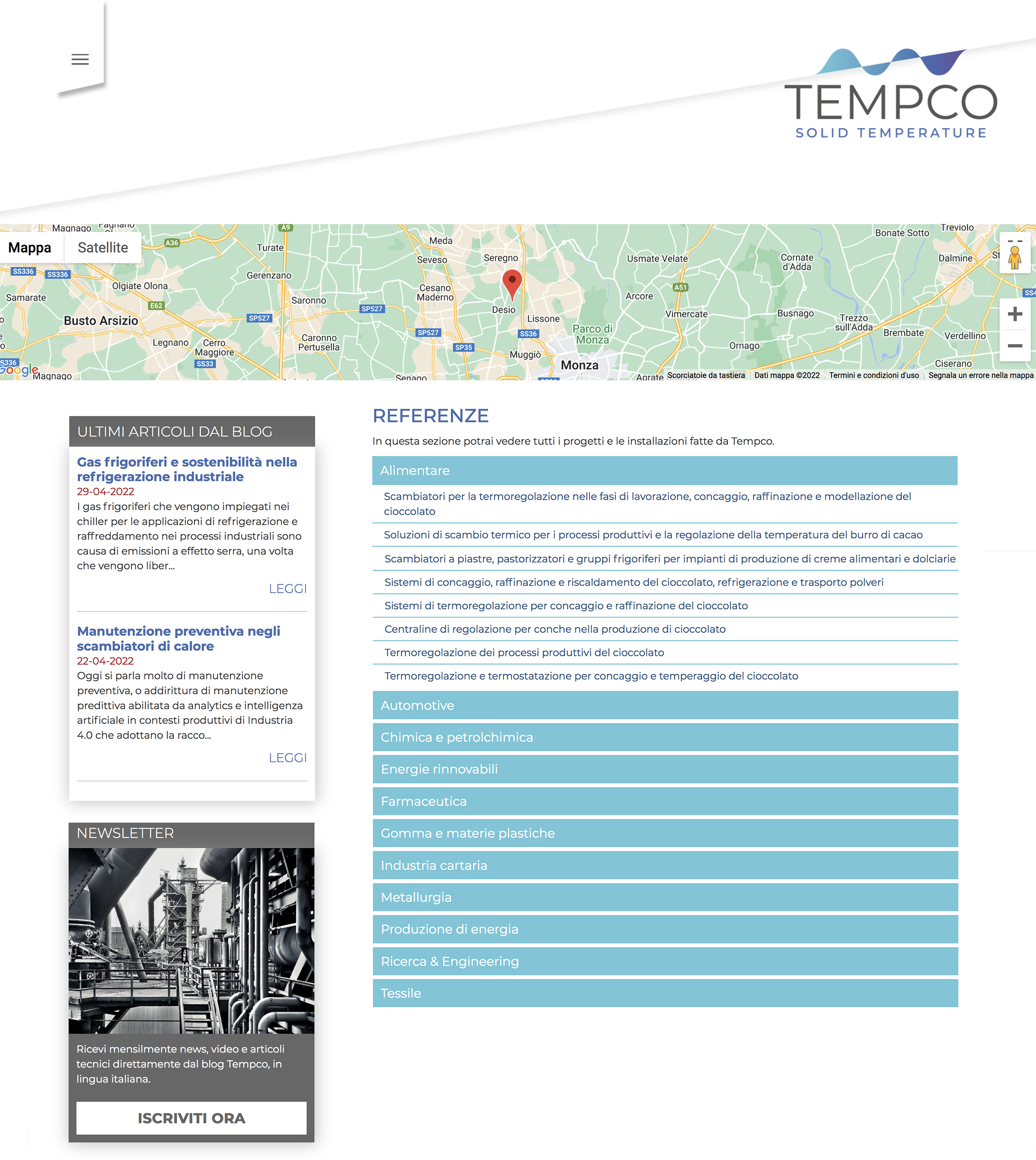
Tempco References of thermal energy management and temperature regulation in industrial production

Tempco referenze applicazioni industriali regolazione temperatura


Emission reduction from refrigerants in industrial chillers

Refrigerants employed in chillers for industrial refrigeration applications are an important source of greenhouse gases once they are released in the environment. That’s why manufacturers of brazed plate heat exchangers, a key component in refrigerating groups and chillers, are committed to deploy more sustainable solutions aimed at reducing the carbon footprint of industrial refrigeration.

Brazed plate exchangers are employed in chillers in function of condensers, in case of water condensation, or as evaporators, which means they function as exchangers between the evaporating refrigerant and the fluid to be cooled, being it water, non-freezing solutions or oil.

The reduction of the environmental impact of industrial refrigeration is possible thanks to the use of micro channel exchangers, plate heat exchangers having a plate design with small pressing depth, approximately 2 mm, or 2,5, 3 mm depending on the type of fluid employed by the heat exchanger.

The challenge is then to create a machine able to ensure the same thermal efficiency but using a reduced amount of refrigerants. The aim is to have less amounts of freon or refrigerant gases in case of release in the environment. Having smaller and tiny passages between the plates of the exchanger allows therefore to have reduced amount of refrigerant flowing, achieving the same thermal work.


Usually, the size of these channels in exchangers must have a certain diameter, in order to avoid fouling and scaling effects, depending on the type of application. In case of chillers, the water flows within the exchangers in a closed-loop circuit and gets filtrated at the beginning, then remaining always the same re-circulated. So that it barely contains particles that can cause fouling or scaling. Furthermore, the exchanger/evaporator works at very low temperature levels, surely lower than temperatures causing carbonates precipitation, thus a further reason why these exchangers are not prone to fouling.

For all of the above reasons, that’s why it’s possible to employ much smaller passages, in fact reducing the amount of refrigerant that flows within the exchanger creating refrigerating groups characterized with a much lower carbon footprint.

Preventive maintenance for heat exchangers efficiency

Preventive maintenance is a very hot topic nowadays, or even predictive maintenance where Industry 4.0 concepts are adopted with data collection and analytics using AI in IoT industrial production contexts. A proper maintenance enabling the prevention of potential problems on industrial machinery and equipments is indeed essential in order to avoid downtimes in production, with related high economic losses.

In case of plate heat exchangers, preventive maintenance can in addition ensure relevant advantages in terms of energy saving, because it ensures to leverage the thermal transfer at its maximum efficiency, as it was originally designed.

The monitoring of some key parameters allows in fact to evaluate the most suitable moment to proceed with a maintenance intervention:

  • increasing values of flow rate pressure drop, compared to design values
  • diminished performances in terms of output temperature levels, compared to design values

Scambiatori a piastre fouling sporcamento manutenzione preventiva


These are two main KPI to check in order to determine if the exchanger need a cleaning and washing service. These two parameters are a key indicator for each kind of heat exchanger: at same capacity, is in fact clear that fouling and scaling on thermal transfer surfaces cause an increase of the pressure drop, being it the pressure difference between inlet and outlet of the fluid. In addition, the thickness of the scaling generates a sort of isolating effect, decreasing the thermal transfer efficiency rate of the exchanger.

Stay updated on the latest applications by subscribing our monthly Tempco Newsletter – Solid Temperature.
High precision thermoregulation in mono fluid mode

The employ of mono fluid thermoregulation is very much common in pharmaceutical and chemical industries production processes, used for the temperature regulation of reactors. Many and diverse are the applications, as these can involve small reactors used in laboratories or big reactors for the production of APIs, but also mixers employed for the mixing of chemical matters or cosmetics.

The basic concept of all these applications remains anyway the same, being it to maintain these systems at a certain temperature to prepare the product inside them thanks to a series of increasing or descending ramps of temperatures, with controlled cycles of heating and cooling.

Reactors are usually jacketed, and a fluid can flow inside the jackets, hot or cold, in order to heat or cool the product on the inside. A simple primary solution is to let different fluids flow within the jacket, for example steam and cold water, to achieve the temperature regulation. But during the switch between the fluids, the jacket must be completely emptied, avoiding potential contaminations of the fluids, and the new fluid must be pumped to completely flow inside the reactor, involving additional technical times.

The best solution is therefore to employ mono fluid thermoregulation, using a unique fluid that continuously flows inside the jacket that step by step gets thermoregulated at the right temperature required to heat or cool the product, by means of heat exchangers and switching valves. Based on a set-point configured by the production of the customer on a PLC, which is connected with the thermogulating unit, valves on the steam exchanger are opened in order to achieve heating, or otherwise commanding the valves on the cold water to cool the fluid that keeps on circulating.

There are clearly several and diverse systems, for example thermoregulating units with electrical heating section and cooling with water, or multiple stage thermoregulating units, steam heating or cooling with tower water or icy cold water, if very low temperatures must be reached. In fact, these are extremely customized thermoregulating units, even considering the fact they often operate in safe or Atex environments, or they are intended for installation within the United States, requiring UL certification, or in the Russian market, needing to be compliant with EAC regulations.

But after all the working principle remains the same, a unique fluid that keeps on circulating on the reactor side, getting heated or cooled by utility fluids that are fed into the thermoregulation unit. The advantages of mono fluid thermoregulation is therefore to have a constant circulation of the fluid, no contamination of working thermal fluids, and finally the possibility to achieve a wide thermoregulation range. With a very precise regulation of temperature and a fine control of the set-points, with strict tolerances, thanks to the use of PID systems, switching valves and highly accurate regulation systems.

Mono fluid thermoregulation in refining plant

Special project for a mono fluid thermoregulating unit in a precious metals refining plant. The unit is aimed at the thermoregulation of reactors. Reactors’ level of temperature is maintained using an array of brazed plate exchangers, using steam as working fluid on the heating circuit and icy cold water on the cooling section. The kind of application involves a very harsh and aggressive working environment, therefore the selection of the kind of materials to be employed has been made based on the long experience and in depth know-how that Tempco has gained on the field, achieving the required goal thanks to the close collaboration between the plant management unit of the customer and the engineering office of Tempco.

Tempco termoregolazione monofluido reattori

In this particular application, the working range has been pushed up, being it a thermoregulating unit that employs pressurized water at a working temperature of 140/150° C, which has to be maintained even for very long process cycle times, leading to very demanding operations.

The brazed plate exchangers installed in the thermoregulating unit are the result of a special engineering, regarding both the layout of the circuit and the design, due to the fact that they have to endure very wide temperature variations, often exceeding 130° C.

Tempco termoregolazione monofluido reattori render

Tempco termoregolazione monofluido reattori scambiatori

Stay updated on the latest applications by subscribing our monthly Tempco Newsletter – Solid Temperature.
Fluids and carbon steel in plate heat exchangers

How connections on plate heat exchangers are made to avoid contact between the fluid and carbon steel? This is a question that I’m often asked for.

If the fluid employed within the exchanger presents no particular problems in getting in contact with carbon steel, the fluid entering the flange of the exchanger gets then in direct contact with the material. Thereafter, it enters the exchanger and here it gets in contact with the stainless steel of the plates. But very often, it is necessary to avoid the contact of the fluids with components and materials that are prone to oxidation and corrosion. In this case, it is mandatory to avoid any possible contact of the fluid with carbon steel

Plate heat exchangers can have two main connection options, with flanged or threaded connections. Flanged connections make the trick quite easy, in fact it’s sufficient to coat the body in the nozzles area using elastomers, such as nitrile, ethylene-propylene or viton, or using stainless steel AISI 304 or AISI 316. The inner part of the body in the nozzle area is protected as well by this lining. The gasket of the first plate gets then in contact with the circular ring of this lining, so that the fluid flowing through the body enters between the first two plates, never getting in contact with carbon steel. The final plate is a blind plate, so it never gets in contact with carbon steel either, remaining always in contact only with the plates in stainless steel.

Speaking of it, fluids never flow between the first plate and the body, they always enter directly between the first two plates.

On plate heat exchangers with threaded connections, the nozzles – made in stainless steel or using plastic materials in case of aggressive fluids such as sea water or acids – have a sort of counterpart which gets in contact with the gasket, and is held back by the body. So that here as well the fluid entering the exchanger gets only in contact with stainless steel and the materials of gaskets. Never getting in contact with carbon steel, paint or other materials that are prone to corrosion.

Finally, the problem doesn’t even exist in plate heat exchangers for food and beverage applications, where hygienic requirements force to employ full stainless steel executions.

Stay updated on the latest applications by subscribing our monthly Tempco Newsletter – Solid Temperature.
Immersion cooling and towers in die casting foundry

Back in 2011, Tempco installed a cooling plant for an important Italian foundry. The cooling plant provides in fact the cooling of several equipments, including induction furnaces, die casting machines for the foundry of metallic parts with steel dies, moulds cooling tanks and cooling tanks for the manufactured parts.

Overall, the cooling plants is composed by:

Tempco raffreddamento fonderia torre di raffreddamento


After more than 10 years of operations, the customer needs to increase the production capacity of the plant. The intervention involved to double the cooling tower and the related water distribution system, due to the fact that the foundry will install new additional induction furnaces and also because the cooling system will have to serve also a new part of the plant aiming for the cooling of die casting machines.

Tempco raffreddamento fonderia conchigliatrici parti metalliche

Tempco raffreddamento fonderia scambiatori TCOIL a immersione

Tempco raffreddamento fonderia scambiatori saldobrasati


Stay updated on the latest applications by subscribing our monthly Tempco Newsletter – Solid Temperature.