
Tempco has implemented an interesting new energy-saving application using custom immersion plate heat exchangers for a client in the parboiled rice production sector. Specifically, for this project, Tempco manufactured and supplied two arrays of custom immersion heat exchangers—each consisting of 20 plates measuring 2500 x 500 mm, made of AISI 316L stainless steel with a 100 mm plate spacing. This custom application is of significant interest to energy managers and technical specialists across various industries, as it is ideally suited for other food and beverage production processes, as well as the chemical and pharmaceutical sectors.
In this specific case, the immersion plate heat exchanger arrays have been installed in the equalization tank, which receives the wastewater generated by the parboiling process—consisting primarily of water used to soak the paddy rice. The purpose of the custom immersion plate heat exchanger is to recover heat from the wastewater, yielding a dual benefit: first, the recovered heat preheats well water circulating within the plates to the highest possible temperature, resulting in significant energy savings by reducing steam consumption. Second, the heat transfer process cools the wastewater before it is sent to the purification plant, providing a substantial advantage for the biological treatment processes taking place there.
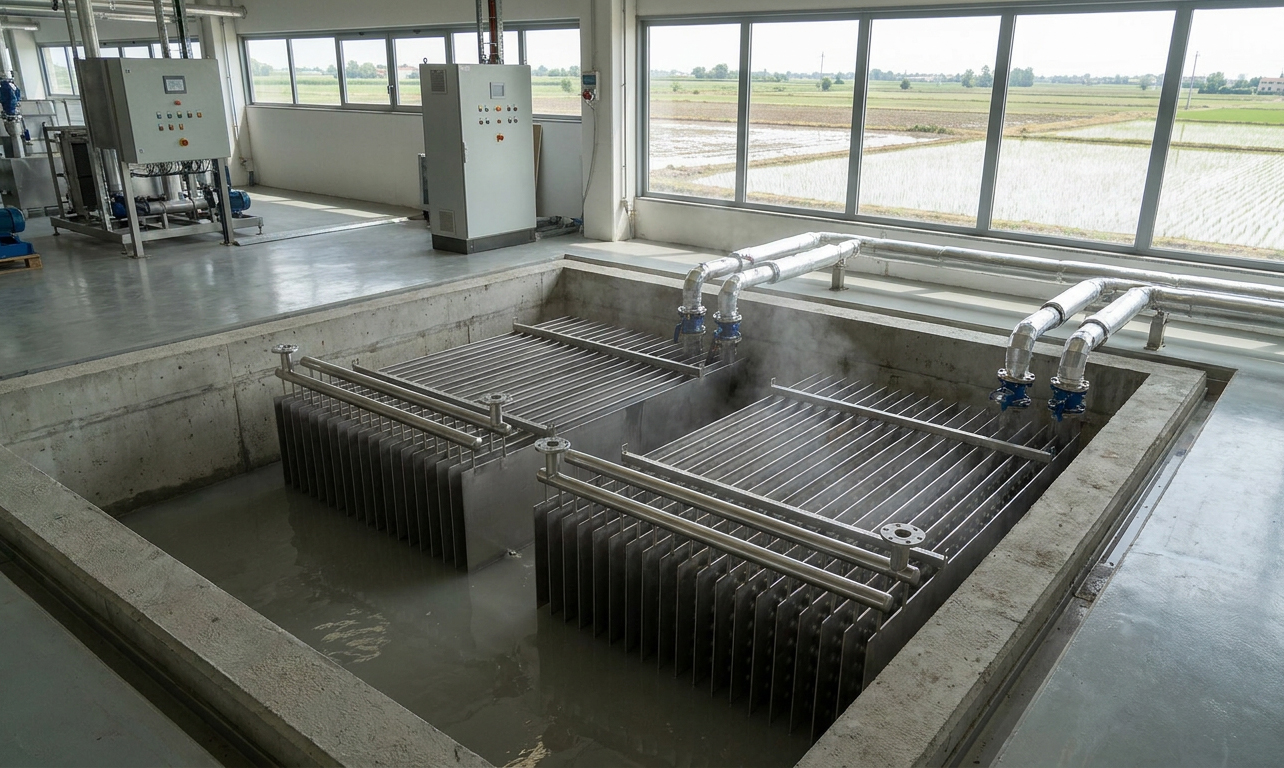
The system was implemented as custom and in retrofit, utilizing existing structures within the client’s equalization tank. Specifically, the existing agitators were leveraged to maintain a fluid velocity of ≥0.1 m/s, generating turbulence that enhances heat transfer efficiency. Furthermore, the immersion heat exchanger arrays were installed by anchoring them to decommissioned aeration pipes (2.0 x 2.6 m).
Overall, the system will enable significant energy savings for the client, recovering approximately 174 kW of heat (150,000 kcal/h) and saving 1,500–1,700 tonnes of steam per year. Material selection for the heat exchanger plates was also critical; AISI 316L stainless steel was chosen to ensure corrosion resistance (handling wastewater with a pH of 3.7–3.9 with no critical chloride levels). Fouling caused by starches in the wastewater was accounted for using a conservative fouling factor (4E-4 m²K/W). Finally, given the intermittent nature of the wastewater flow—process wastewater is discharged every two hours, though a minimum volume is always maintained in the tank—performance was calculated at 70% of the theoretical maximum to determine the system’s ROI.