
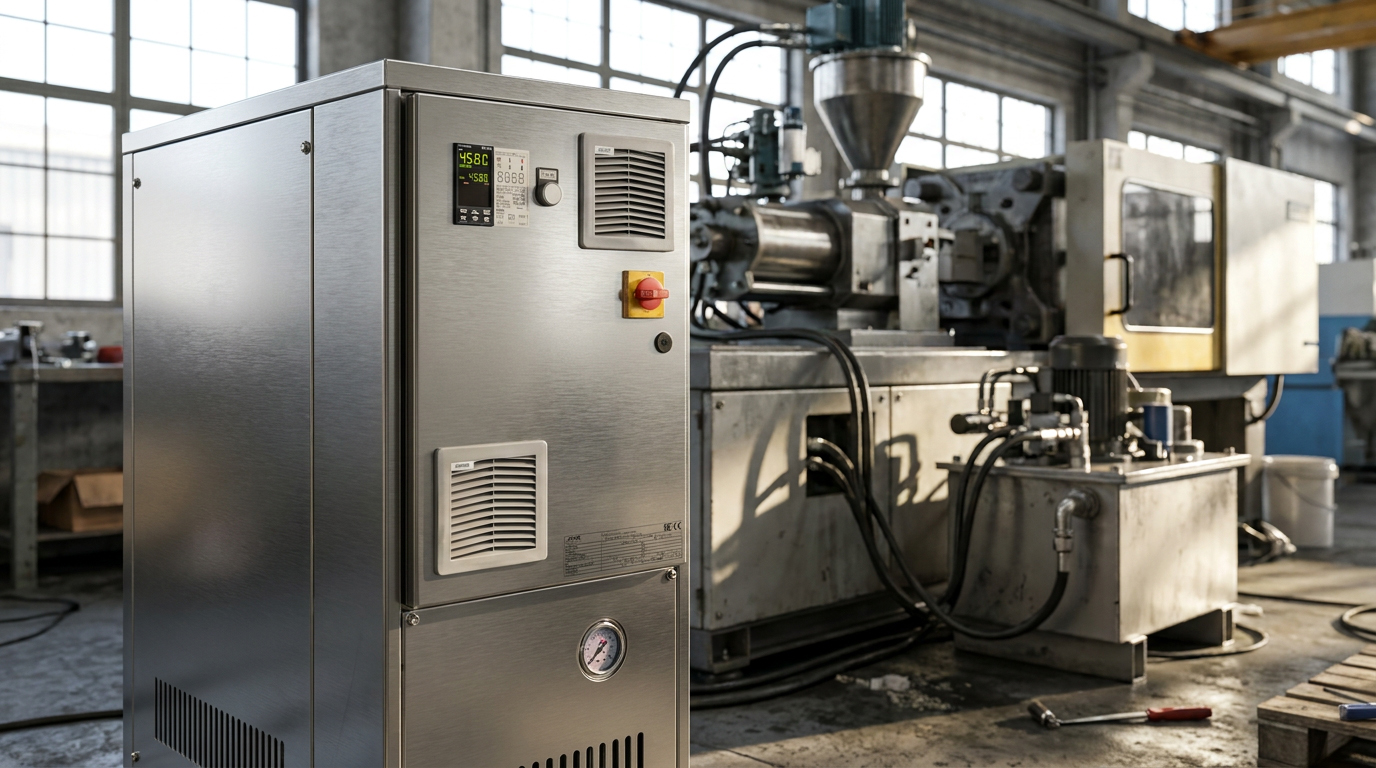
In precision temperature control, the correct sizing of heat exchangers is more important than having an excess of power. In fact, an oversized heat exchanger was the root cause of heating element failure in a temperature control unit (TCU) used for the injection molding of a PP-based composite material. The client—an overseas company—contacted Tempco to investigate the underlying cause of the malfunction.
Our first step was to collect process data during an on-site visit conducted by the Tempco partner:
- a steel mold weighing ~12 tons, with a throughput of ~60 kg/h;
- 4 temperature control zones, managed by 3 TCU operating at 60, 80, and 100 °C;
- cooling water available at 15 °C;
- the material is heated up to ~250 °C for injection and subsequently cooled down to ~80 °C;
- actual cooling load required: ΔT 170 °C × 60 kg/h × specific heat capacity (Cs) 0.45 ≈ 5.3 kW net;
- highly stable process temperature.
As previously mentioned, the client’s issue involved the failure of the heating elements within their temperature control units (TCUs). A joint analysis conducted by Tempco and our local partner identified the likely cause: thermal shock resulting from a significantly oversized plate heat exchanger—60 kW capacity, compared to an actual cooling duty required of only ~5.3 kW. With such an oversized exchanger, combined with an on/off cooling solenoid valve, every activation delivers a sudden, disproportionate cooling ‘jolt’. This causes sharp thermal fluctuations in the process water, leading the heating elements to develop cracks and eventually fail. This is a classic example of how over-sizing the capacity of a heat exchanger does not enhance operational reliability.
Solutions proposed by Tempco
Basically, our preferred solution would have been to replace the on/off solenoid valve with a ½” or ¾” proportional/modulating valve, allowing for gradual cooling control. However, the ASCON temperature controller installed in the client’s TCU does not support a modulating valve, and retrofitting one would be highly invasive.
The practical, immediately implementable solution was to install a manual valve on the cooling water inlet to throttle the flow to a minimum, paired with a solenoid valve properly sized upon this reduced flow rate.
For future units, it is therefore advisable to install a heat exchanger sized according to the actual power requirements, equipped with a solenoid valve matched to the minimum necessary flow rate.