Tempco is very pleased to share a new application case that combines industrial thermoregulation and the circular economy. Our TREG diathermic oil thermoregulation unit has been chosen for the pilot site of a major European project, installed at the end customer’s site in the Turin area.
The project aims to transform waste treatment into an advanced energy process: increasing biomethane production while simultaneously converting non-recyclable waste into syngas (gas mixture obtained from the gasification of biomass or carbon-based waste), through thermochemical processes such as gasification and pyrolysis.
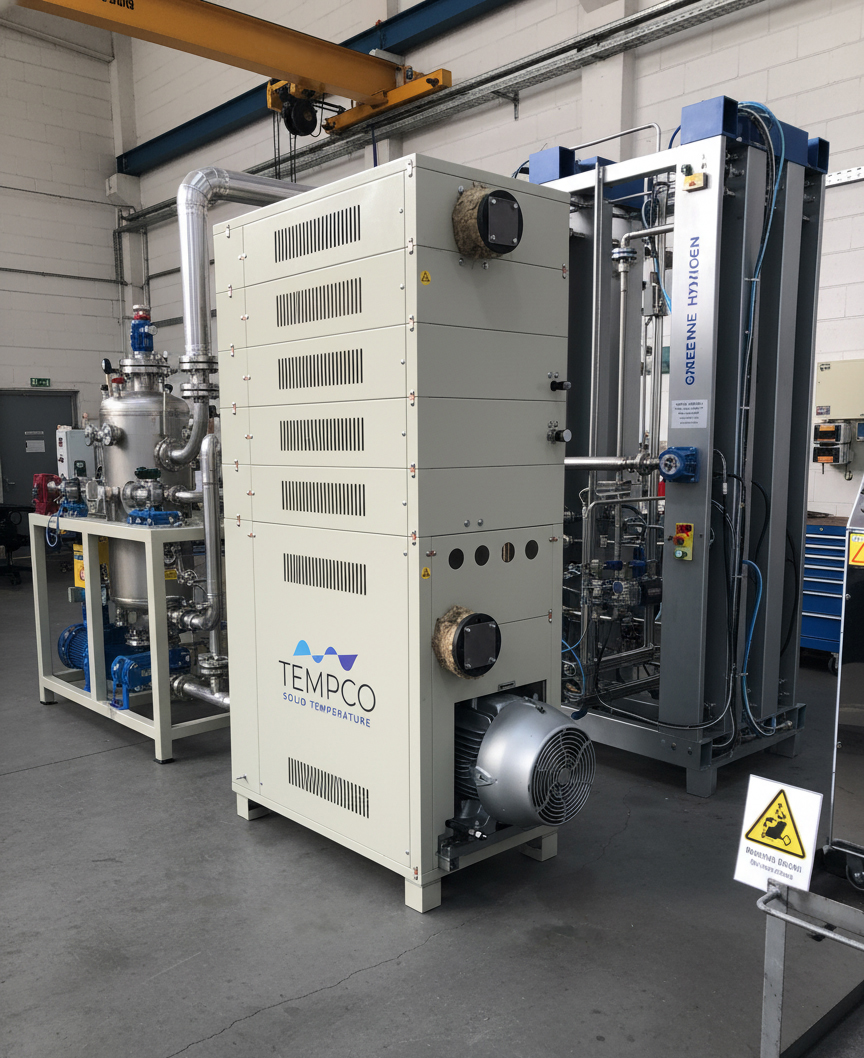
For these processes, heat regulation is critical: the heat supplied to the process must be stable, precise, and available at high temperatures. The Tempco control unit is therefore designed to ensure the required temperature regulation with maximum levels of safety and operational continuity of the system.
Our TREG meets these requirements precisely:
- It works with diathermic oil at high temperatures, ensuring proper thermal decomposition of the materials.
- ATEX certification, essential in environments with potentially explosive atmospheres.
- Remote control, which allows for remote management of process parameters, reducing on-site interventions and increasing operational continuity.
From waste to Syngas: a closed cycle
TREG’s seamless integration into the project therefore represents a concrete example of circular economy applied to energy, with a green perspective and fostering sustainable energy transition:
- Waste becomes a resource: materials that were previously a disposal cost are now transformed into an energy-rich gas.
- The district becomes more self-sufficient, thanks to a process that recovers value from flows considered to be at their end-life cycle, achieving circularity.
- Lower emissions and greater efficiency, because high-temperature thermoregulation makes the entire conversion cycle stable and reliable.