
Single-fluid thermoregulation is widely used in the pharmaceutical industry; Tempco recently supplied a TCU (Temperature Control Unit) to regulate the temperature of a glass-lined pharmaceutical reactor with a capacity of approximately 8,000 liters.
A natural question arises: why not feed utility fluids (glycol, water, steam) directly into the reactor jacket? While this might seem like the simplest approach, for glass-lined reactors, it would be a perfect recipe for disaster. Glass linings are highly sensitive to sudden temperature fluctuations; injecting steam at 8 bar immediately after glycol at -15°C risks causing catastrophic cracking.
The solution lies in the adoption of the mono-fluid temperature control concept across an extended range: a single heat-transfer fluid circulates continuously within the jacket’s closed loop, while three utility fluids (glycol at -15° C, industrial water at 25° C, and steam at 8 bar) condition its temperature outside the reactor itself.
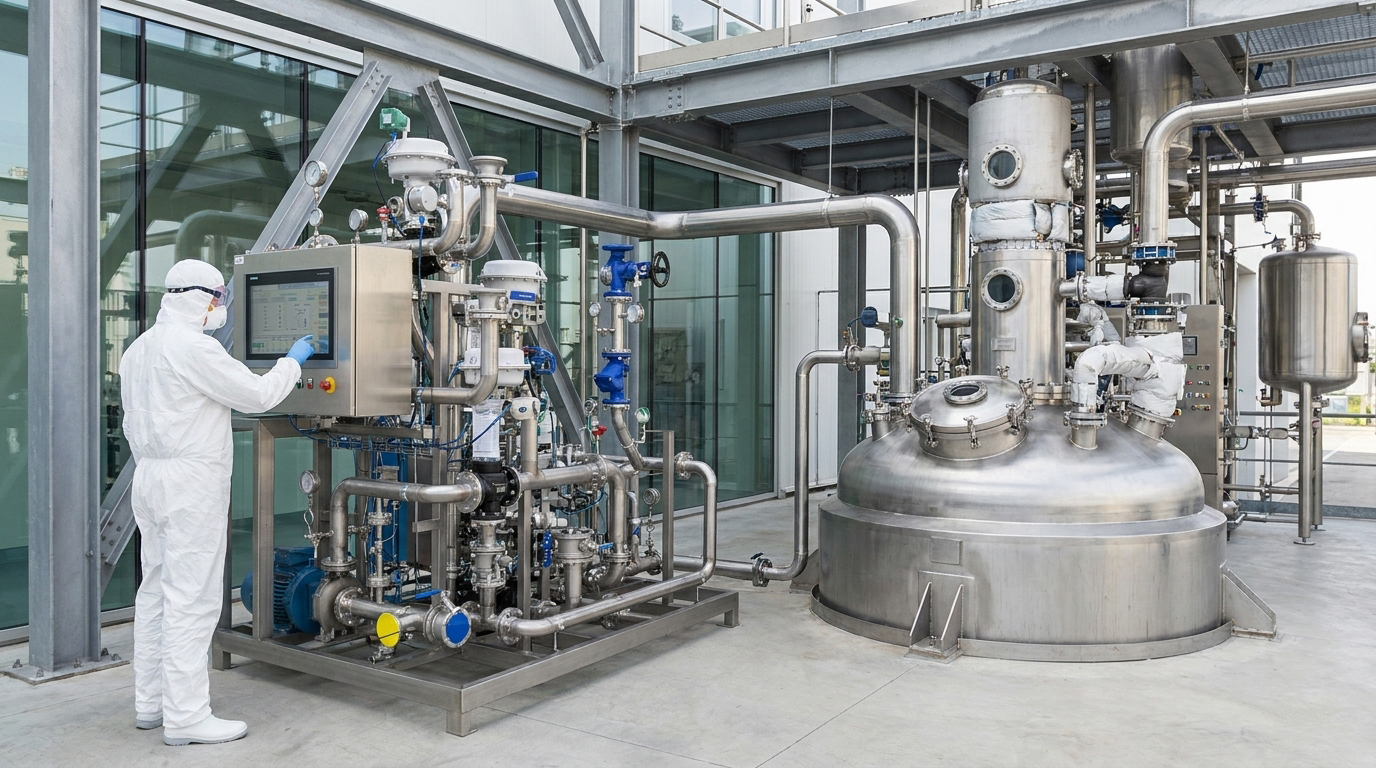
The resulting advantage is clear: the intermediate fluid acts as a thermal buffer, ensuring excellent temperature uniformity across the vessel wall, thermoregulation precision within a tenth of a degree, and the elimination of thermal shock to the glass lining.